Air scrubbers are rated in cubic feet per minute (CFM), while Australian rooms are measured in metres. That mismatch is where most sizing mistakes start. Once you convert the units and allow for real-world losses, choosing the right scrubber, or the right number of scrubbers, is straightforward.
The formula
Air changes per hour (ACH) = airflow per hour ÷ room volume
In imperial units:
- ACH = CFM × 60 ÷ room volume in cubic feet
In metric units:
- ACH = airflow in m³/h ÷ room volume in m³
The conversions you need:
- 1 m³ = 35.31 ft³
- 1 CFM ≈ 1.70 m³/h (so 500 CFM ≈ 850 m³/h, 1000 CFM ≈ 1,700 m³/h, 2000 CFM ≈ 3,400 m³/h)
Room volume is simply length × width × ceiling height. Measure the actual ceiling height; raked ceilings and older homes with 3 m-plus ceilings change the answer significantly.
Worked examples with Thorair scrubbers
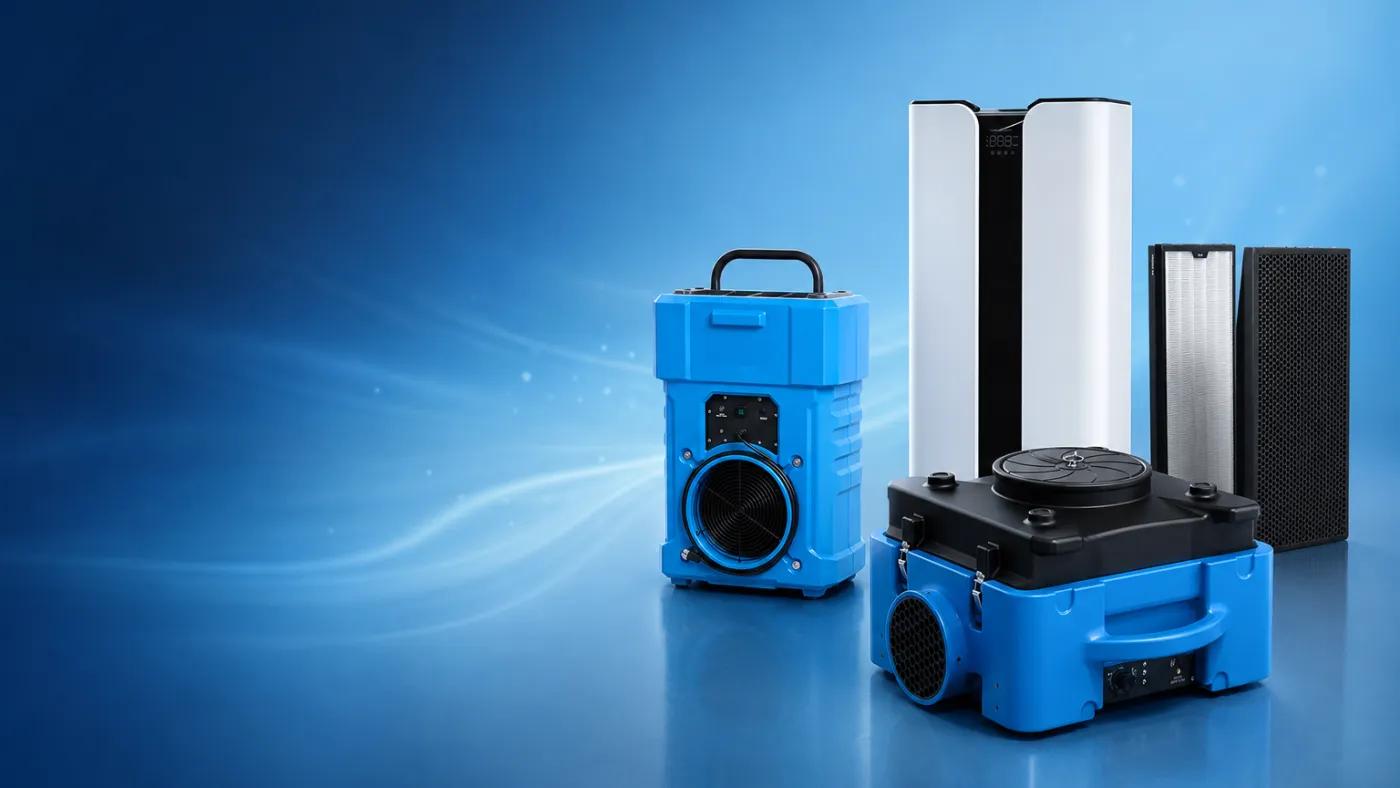
A bedroom with the 500 CFM scrubber
A 6 m × 5 m room with a 2.4 m ceiling:
- Volume: 6 × 5 × 2.4 = 72 m³, or 72 × 35.31 ≈ 2,542 ft³
- Imperial: 500 × 60 = 30,000 ft³/h ÷ 2,542 ≈ 11.8 ACH
- Metric: 850 m³/h ÷ 72 m³ ≈ 11.8 ACH
On paper, the compact 500 CFM HEPA air scrubber turns this room's air over nearly 12 times an hour. That leaves a healthy margin once real-world losses are applied (see below).
An open-plan living area with the Hulk 1000
A 12 m × 10 m open-plan area with a 2.7 m ceiling:
- Volume: 12 × 10 × 2.7 = 324 m³, or about 11,440 ft³
- 1000 × 60 = 60,000 ft³/h ÷ 11,440 ≈ 5.2 ACH
The Hulk 1000 CFM scrubber gives just over five air changes per hour at nameplate airflow. Whether that is enough depends on your target and how much the airflow drops in use.
The same space with the Hulk 2000
- 2000 × 60 = 120,000 ft³/h ÷ 11,440 ≈ 10.5 ACH
The Hulk 2000 CFM commercial scrubber roughly doubles the air changes in the same space, which matters when demolition is kicking up dust or the containment is large.
Summary table
Nameplate ACH for common room volumes (before derating):
| Room volume | 500 CFM | 1000 CFM | 2000 CFM |
|---|---|---|---|
| 40 m³ (small bedroom) | 21 | 42 | 85 |
| 72 m³ (large bedroom) | 12 | 24 | 47 |
| 150 m³ (living area) | 5.7 | 11 | 23 |
| 324 m³ (open plan) | 2.6 | 5.2 | 10.5 |
| 600 m³ (small commercial) | 1.4 | 2.8 | 5.7 |
Derate for the real world
Nameplate CFM is measured with clean filters and a free outlet. On a job, airflow falls for several reasons:
- Loaded filters. As the pre-filter and HEPA filter collect dust, resistance rises and airflow drops. A clogged G4 pre-filter is the most common cause of a scrubber underperforming.
- Ducting. Running lay-flat or PVC negative pressure duct adds resistance. Long runs, bends, kinks and crushed sections add more.
- Speed setting. Units run on a lower speed for noise reasons move less air.
There is no single correct derating figure, because it depends on filter condition and the duct run. Some technicians plan on around 70% of nameplate airflow for ducted setups with part-loaded filters, then check the result. Using that assumption, the 500 CFM unit in the bedroom example drops from 11.8 to about 8.3 ACH, and the Hulk 1000 in the open-plan area drops from 5.2 to about 3.7 ACH.
Working backwards: how much CFM do I need?
Rearrange the formula to find the airflow you need:
- Required CFM = room volume in ft³ × target ACH ÷ 60
For the 324 m³ open-plan area with a target of 6 ACH:
- 11,440 × 6 ÷ 60 ≈ 1,144 CFM of effective airflow
- Allowing for 70% effective airflow: 1,144 ÷ 0.7 ≈ 1,634 CFM nameplate
That points to a Hulk 2000, or two Hulk 1000 units placed at opposite ends of the space. Two machines often give better air mixing than one large one, and they give you redundancy if one needs a filter change mid-job.
What ACH should you aim for?
Targets vary between guidance documents, job types and the level of contamination, so treat these as general reference points rather than rules:
- For general air cleaning during drying, a common starting point is around 4 ACH.
- For mould remediation and dusty demolition inside containment, many practitioners aim for 6 ACH or more.
- Where the scrubber is also creating negative pressure, the exhaust volume must be enough to hold the containment under negative pressure, which is a separate check covered in our negative air pressure guide.
Mould remediation standards such as IICRC S520 discuss air filtration and containment in more detail. For contaminated or large jobs, follow the relevant standard and a qualified professional's scope.
Placement tips that change the result
- Place scrubbers so the air travels across the whole space before reaching the intake. A unit in a corner next to the door can end up recirculating the same air.
- Keep intakes clear of walls, furniture and plastic sheeting that can be sucked in.
- In recirculating mode, point the exhaust away from settled dust so you are not stirring it back up.
- Check and change pre-filters regularly. They are cheaper than HEPA filters and protect them.
Use the air scrubber calculator to run the numbers for your own rooms, and the air scrubber comparison to see the 500, 1000 and 2000 CFM units side by side.