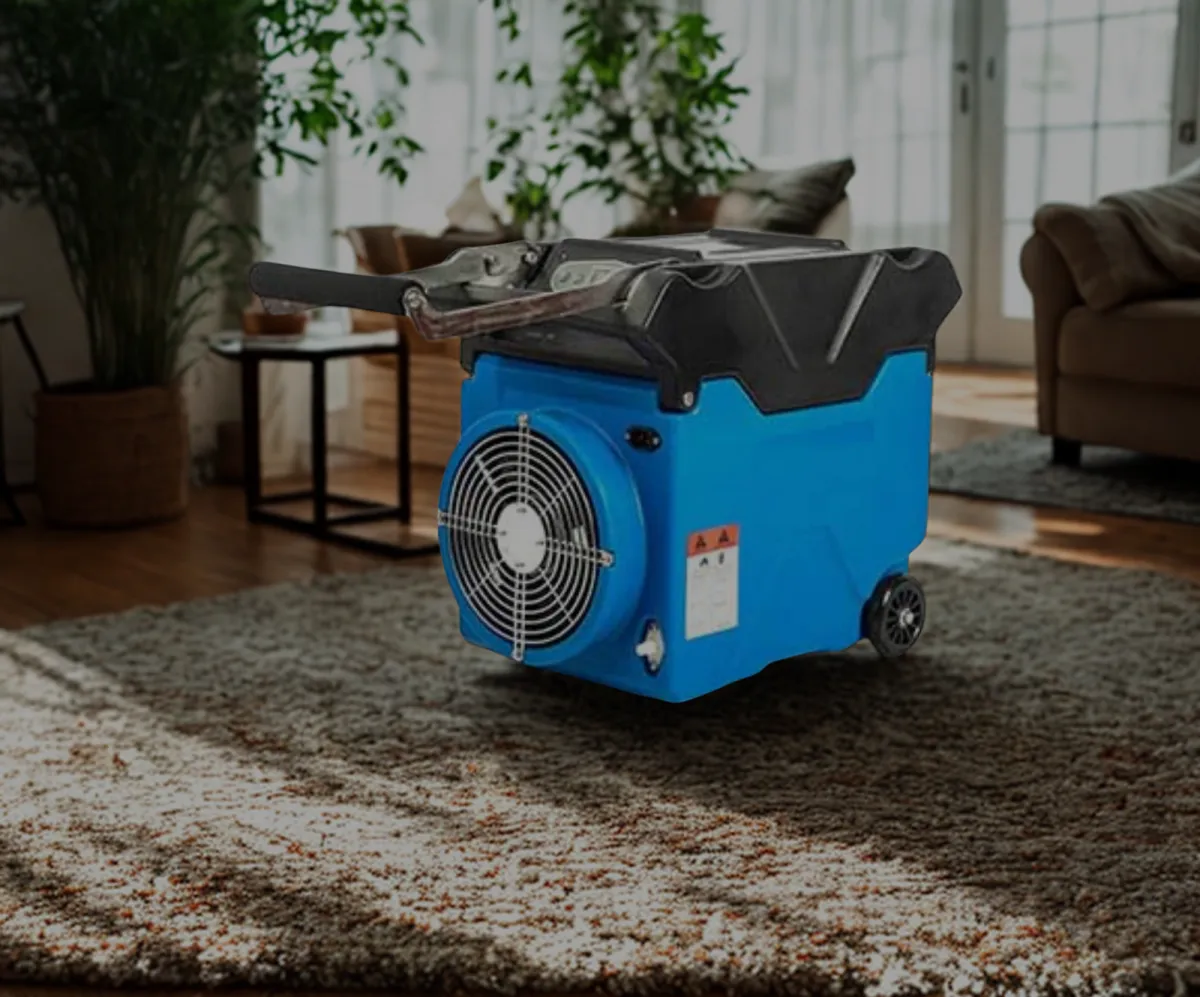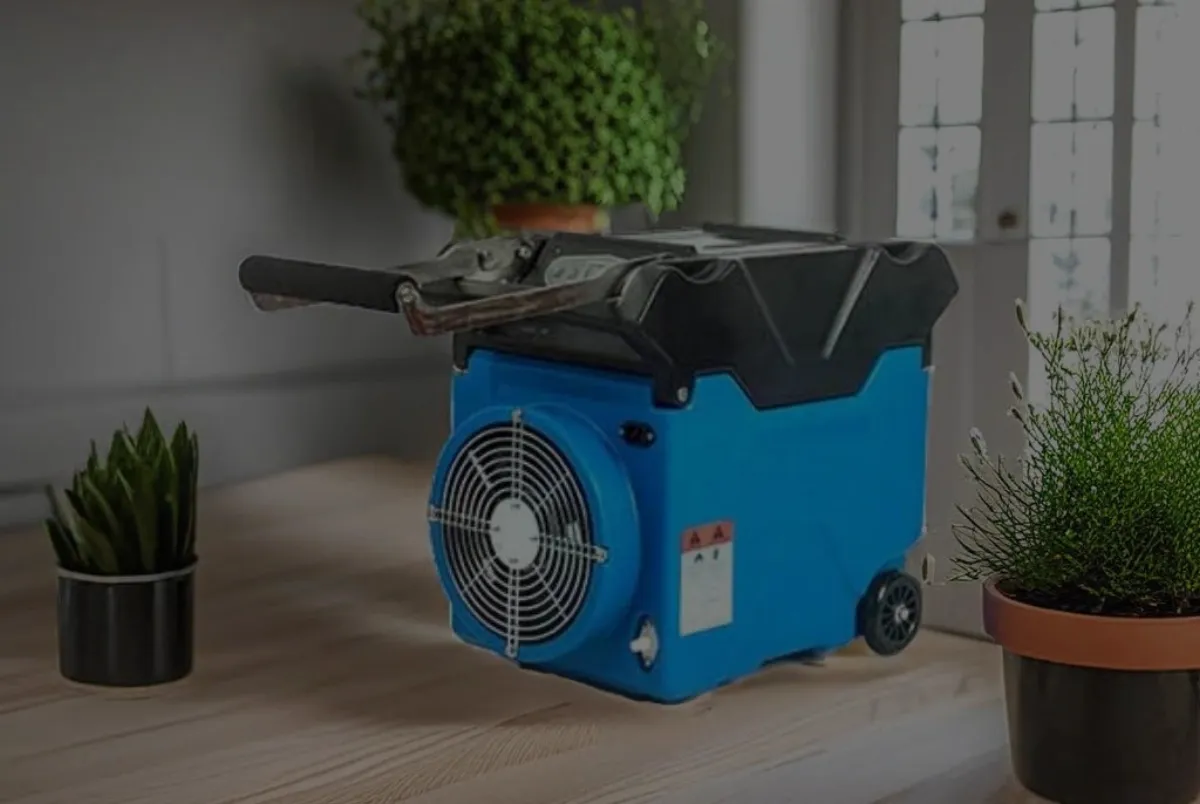
Every dehumidifier has one task on a drying job: lower the water vapour in the air so wet materials dry faster. How it does that decides where it works well and where it stalls.
First, a quick word on grains and grain depression
Relative humidity (RH) on its own is a poor guide on a drying job because it changes with temperature. Restorers track specific humidity instead: the actual weight of water in the air. In the industry this is usually expressed in grains per pound (GPP) of dry air. If you are more used to metric, 1 g/kg is roughly 7 GPP.
Grain depression is the difference between the GPP of air going into a dehumidifier and the GPP of air coming out. A unit taking in 70 GPP air and discharging 45 GPP air has a grain depression of 25. The bigger the depression, the more water the machine is removing from each pass of air.
What matters on a real job is how well a machine keeps producing grain depression as the room dries out. That is where the three technologies separate.
Conventional refrigerant dehumidifiers
A refrigerant dehumidifier works like an air conditioner in reverse. A fan draws air across a cold evaporator coil. Water vapour condenses on the coil, drips into a tank or drain, and the air passes over the hot condenser coil before leaving the unit slightly warmer and drier.
They are efficient and inexpensive in warm, humid air. The limitation is the coil temperature. Once the air's dew point drops close to the coil temperature, little more water condenses. In practice a standard refrigerant unit tends to level off while the air is still fairly moist, which is often right when the last stubborn materials still need to dry. In cooler rooms the coil can also frost up, and output drops further.
These units are fine for household damp and light-duty work, but they tend to leave the tail end of a structural drying job dragging on.
Low grain refrigerant (LGR) dehumidifiers
An LGR dehumidifier uses the same refrigeration principle with a redesigned system. The typical changes are a pre-cooling heat exchanger that chills incoming air before it reaches the evaporator, careful refrigerant metering and larger coil surfaces. The result is that the machine can keep condensing water from air that a conventional unit would treat as "dry enough".
In practice, that means:
- More grain depression at low GPP. An LGR unit can keep pulling the air down to drier levels, which keeps the vapour pressure difference between wet materials and room air high.
- Faster finish. Dense materials such as timber framing, subfloors and concrete give up their moisture more readily when the air stays dry.
- Better performance in cooler rooms. Good LGR units handle lower temperatures and include automatic defrost.
For most water damage in Australian homes and commercial fit-outs, LGR is the default choice. Rooms are usually warm enough, the drying chamber can be closed off, and the job needs to reach dry standard, not just "less wet".
Desiccant dehumidifiers
A desiccant dehumidifier does not rely on condensation. Air passes through a slowly rotating wheel coated in a moisture-absorbing material, commonly silica gel. The wheel adsorbs water vapour from the process air, which leaves the unit very dry. A separate stream of heated air passes through another section of the wheel to drive the moisture off, and that warm, wet reactivation air is ducted outside.
Because it does not need a cold coil, a desiccant unit keeps working in cold spaces and can reach very low humidity. The trade-offs:
- They generally draw more power because of the reactivation heater.
- They need ducting and an exhaust point for the wet air.
- They warm the space, which can help or hinder depending on the job.
Side-by-side comparison
| Conventional refrigerant | LGR (low grain refrigerant) | Desiccant | |
|---|---|---|---|
| How it removes water | Condenses on a cold coil | Condenses on a cold coil, with pre-cooling | Adsorbs onto a rotating wheel |
| Best conditions | Warm, humid air | Warm to mild air, from wet to fairly dry | Cold spaces and very low humidity targets |
| Performance as air dries | Levels off early | Keeps working to lower GPP | Keeps working to very low GPP |
| Cold rooms | Output falls, coil may frost | Better, with auto defrost | Unaffected by cold |
| Setup | Tank or drain hose | Drain hose or pump | Needs exhaust ducting |
| Typical use | Homes, light damp | Most structural drying | Hardwood floors, cold sites, large commercial |
When LGR wins
LGR is the practical choice when:
- The affected area can be closed into a drying chamber.
- Room temperature is mild to warm (most Australian interiors most of the year).
- You are drying typical building materials: plasterboard, carpet and underlay, timber framing, particleboard flooring and moderate amounts of concrete.
- You want one machine type that covers the whole job from the wet start to the dry finish.
When you need desiccant
Consider desiccant equipment when:
- The space is cold, such as an unheated building in a Canberra or Tasmanian winter, or a cool store.
- You need very low humidity to pull moisture from dense hardwood flooring, or from concrete slabs with a moisture-sensitive floor covering waiting to go down.
- The drying area is very large or open and you can duct air in and out.
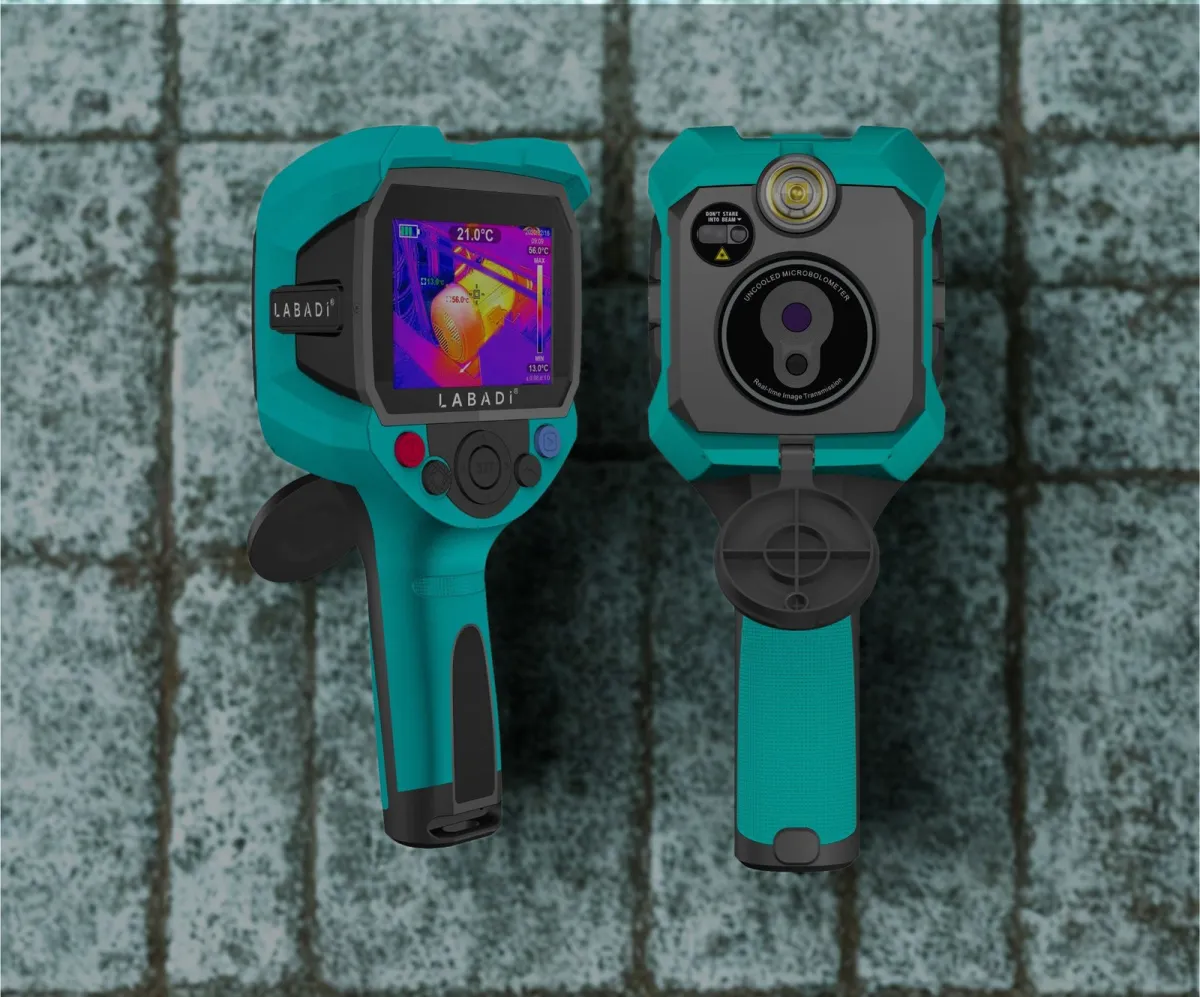
Many restorers run LGR units for most jobs and hire desiccant capacity when needed. Either way, moisture readings tell you whether a job is progressing.
Where the Thorair range fits
All three current Thorair dehumidifiers use LGR refrigeration with Panasonic compressors:
- The Pro LGR 50L dehumidifier is rated at 50 L/day at 30°C and 80% RH, weighs 35 kg, works down to 2°C and has auto defrost and a continuous drain. It is stackable, which suits vans and storage.
- The 70L dehumidifier adds a humidistat and timer, with a washable filter.
- The Pro LGR 90L dehumidifier moves 600 CFM and suits larger rooms or heavier water loads. Like the 50L, it is stackable.
Thorair does not currently list a desiccant unit. If your work regularly involves cold sites or timber floors, plan for that capacity separately. To choose between the LGR sizes, see what size dehumidifier do I need, or compare specifications on the dehumidifier comparison page. For how dehumidifiers fit into a full drying setup, see water damage restoration.