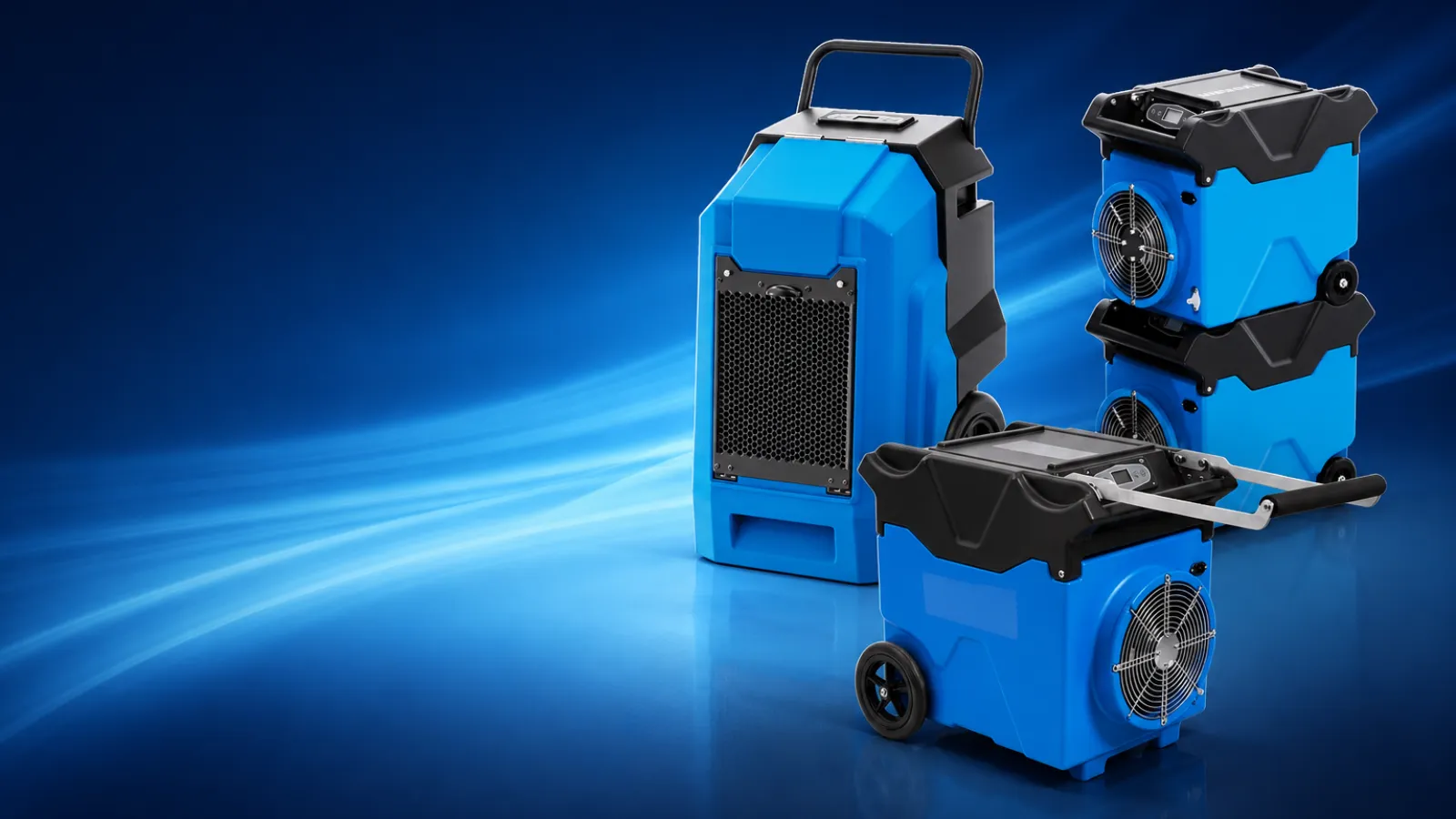
Most people start with the number on the box: 50, 70 or 90 litres a day. That figure is useful for comparing machines, but it will rarely match what you empty out of the drain on a real job. Sizing well means understanding why.
Rated capacity versus real-world extraction
Dehumidifier capacity is measured in a test chamber at fixed conditions. Thorair quotes the Pro LGR 50L at 30°C and 80% RH, which is warm, very humid air. That is roughly the air in a sealed room on day one of a summer flood job, and it is where a refrigerant dehumidifier removes water fastest.
Other standards use different conditions. The US AHAM test, for example, uses cooler and drier air, so the same machine will show a lower litre figure under AHAM than under a 30°C/80% RH rating. When you compare brands, check that both figures come from the same test conditions.
On site, extraction falls as conditions move away from the test point:
- Cooler air means less water vapour to condense and a colder coil that may need to defrost.
- Drier air is the goal of the job, but every step closer to dry standard gives the machine less water to pull out.
As a rough guide, expect real-world extraction to be a fraction of the rating once the room has come down from its wettest state. That is normal. It is also why LGR units matter: they keep extracting as the air dries (see LGR vs refrigerant vs desiccant).
The three things that actually set the size
1. Room volume
Dehumidifiers treat air, so start with volume, not floor area. Measure length × width × ceiling height in metres. A 5 m × 4 m bedroom with a 2.4 m ceiling is 48 m³. An open-plan living area of 10 m × 6 m at 2.7 m is 162 m³.
Include any spaces open to the affected area. If a hallway and kitchen share air with the wet lounge and you cannot close them off, they are part of your drying chamber.
2. Class of water loss
The IICRC S500 standard groups jobs into classes by how much water is present and how hard the materials are to dry. In simple terms:
- Class 1: a small area, little water absorbed, mostly low-porosity materials.
- Class 2: a whole room of carpet and underlay wet, with water wicked a short way up the walls.
- Class 3: water from above, with ceilings, walls, insulation and carpet saturated.
- Class 4: "specialty drying" of dense or low-permeance materials such as hardwood, concrete, plaster and stone that hold water tightly.
Higher classes put more water into the air, so they need more dehumidification per cubic metre. Class 4 materials release water slowly, which calls for drier air and patience rather than simply more machines.
3. Conditions on site
Temperature, how well the area can be sealed, outdoor humidity and whether windows are open all change the load. A sealed, warm room with no leaks is far easier to dry than a draughty house with doors opening all day.
So: 50L, 70L or 90L?
These are starting points, not rules. Always confirm with daily readings.
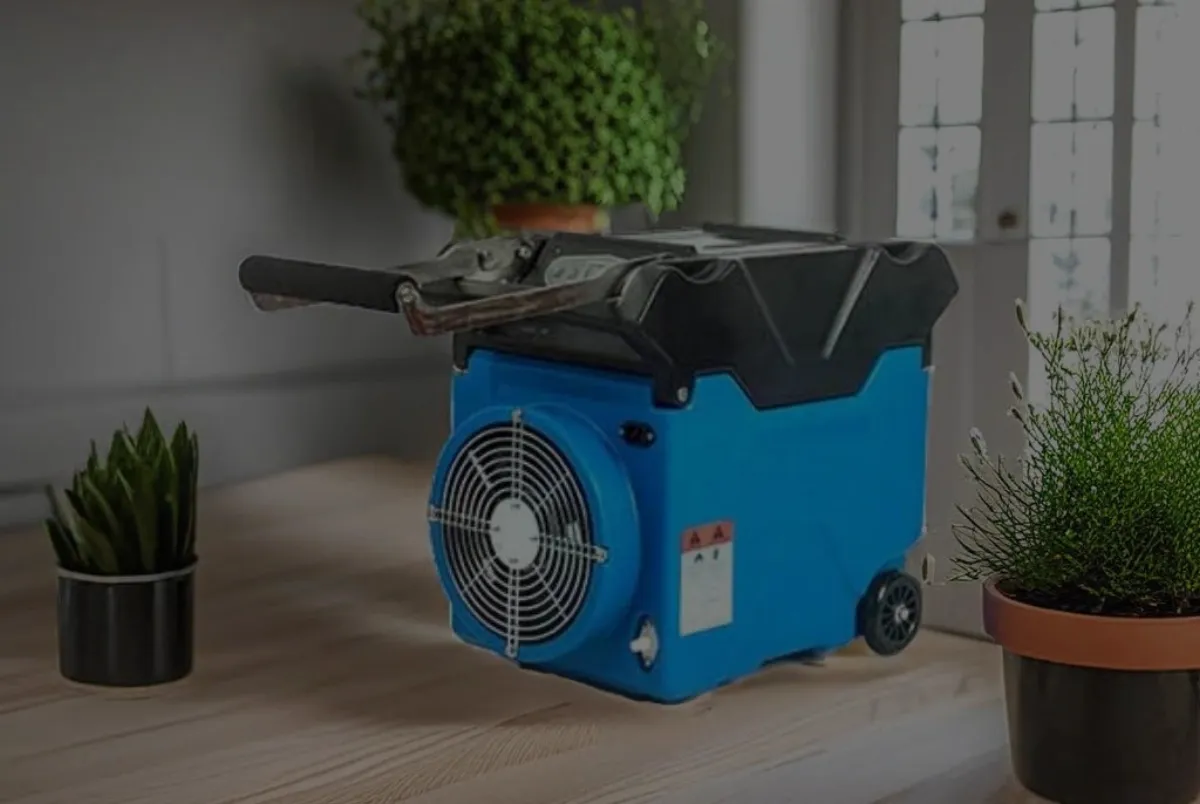
50L (Thorair Pro LGR 50L). A good fit for single rooms, bathrooms, bedrooms and small Class 1–2 jobs. At 35 kg it is the easiest to carry up stairs, and it is stackable. Smaller units are also easy to split across rooms on a multi-room job.
70L (Thorair 70L). A middle option for larger rooms or small apartments, with a built-in humidistat and timer that also make it useful for ongoing humidity control in storage areas and basements.
90L (Thorair Pro LGR 90L). Suited to open-plan areas, Class 3 jobs and commercial spaces where you would otherwise need two smaller units. It moves 600 CFM of air, so it turns over a large volume.
How many units?
A common starting point is to estimate the total daily capacity you need from volume and class, then divide by the realistic capacity of each unit. Our dehumidifier size calculator does that arithmetic for you and suggests a mix of units.
Some practical points:
- Two smaller units can beat one large one. They spread drying across separate rooms and give you redundancy if one needs servicing.
- One large unit is simpler in a big open space. Fewer power leads, fewer drain hoses and one set of readings.
- Air movers change the equation. Air movers pull water out of materials and into the air, and dehumidifiers must keep up. If you add air movers, check whether dehumidification needs to go up too. See how many air movers per room.
- Watch the numbers. If room GPP is not falling after the first 24 hours, or dehumidifier grain depression is small while materials are still wet, add capacity.
A worked example
A lounge room of 7 m × 5 m with a 2.7 m ceiling (about 95 m³) has wet carpet, wet underlay and water wicked 300 mm up the plasterboard: a typical Class 2 job. The house is closed up and it is late summer.
A reasonable first setup is one Pro LGR 90L or two Pro LGR 50L units, plus air movers along the wet walls and under the lifted carpet. Take readings at setup and again the next day. If the room's GPP is dropping and materials are trending down, the setup is right. If not, add a unit rather than waiting.
Where to go next
Compare the full specifications side by side on the dehumidifier comparison page. If you are building a kit from scratch, the equipment packages combine dehumidifiers, air movers and scrubbers in one order.