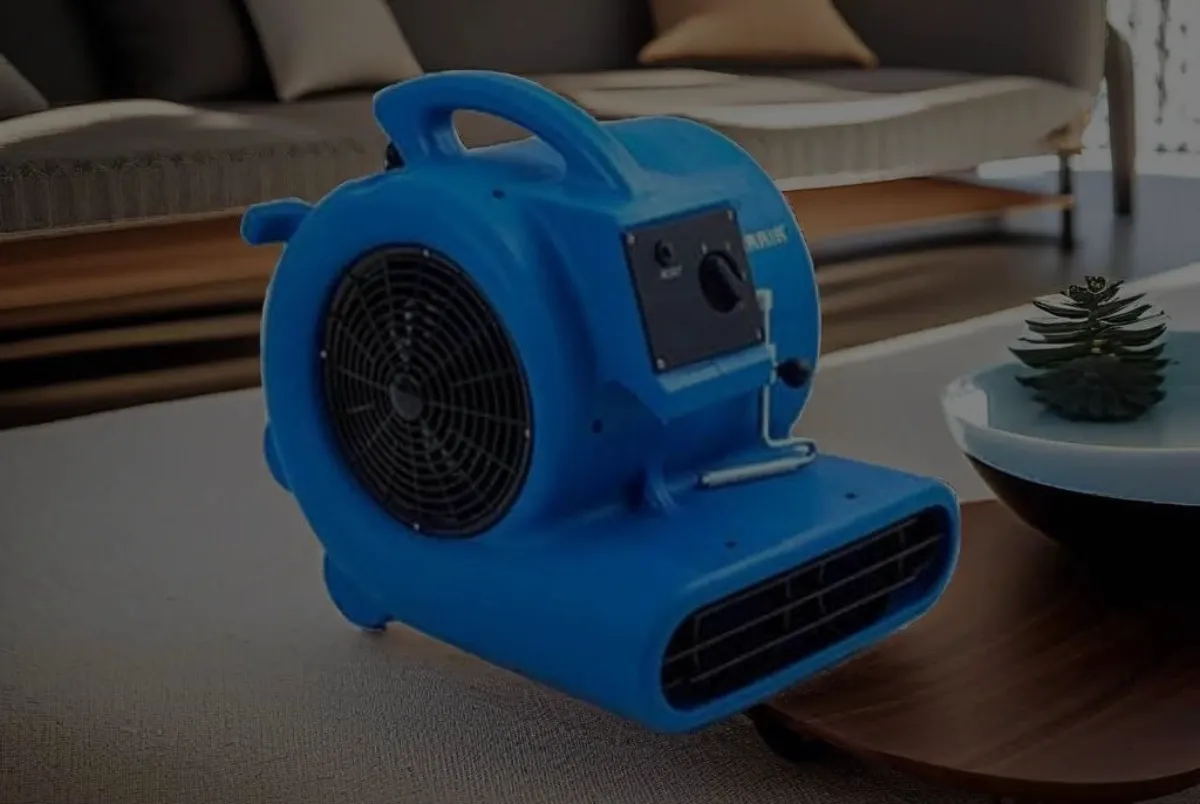
An air mover's job is simple: push a fast, low sheet of air across wet surfaces so moisture evaporates faster. Water leaves a material through a thin boundary layer of saturated air sitting on its surface. Strip that layer away continuously and evaporation speeds up. How well a particular air mover does that on a given surface comes down to its fan type and housing.
Two numbers that matter: CFM and static pressure
CFM (cubic feet per minute) is the volume of air the unit moves. Higher CFM covers more area.
Static pressure is how hard the fan can push against resistance. Resistance comes from carpet that has to be lifted, a narrow cavity, a long duct or hose, or a filter.
The two trade off against each other:
- Centrifugal fans (the kind inside snail, square and turtle housings) draw air into the centre of a spinning wheel and fling it outwards. They generate good static pressure, so they keep pushing air when something is in the way.
- Axial fans (like a pedestal fan, or a downdraft unit) move a large volume of air with little pressure. They excel in open space but lose output quickly against resistance.
A high CFM figure alone does not make an air mover better. For floating carpet or drying inside wall cavities, pressure matters more. For drying a large open slab, volume matters more.
Snail (centrifugal) air movers
The classic restoration air mover: a curved, shell-shaped housing with an outlet that can be angled flat to the floor, tilted up a wall or pointed under a lifted carpet edge.
Best for: floating carpet, drying walls and floors, pushing air into cavities with attachments. Their static pressure makes them the go-to for lifting carpet off underlay or subfloor.
Watch for: they are bulkier to store and stack less neatly than square units, and full-size models draw more current.
Thorair options:
- The Pro Snail carpet blower delivers 900, 1,000 and 1,350 CFM across three speeds, is rated at 550 W and has a 7.5 m cord, which helps reach outlets without extension leads.
- The Mini Snail carpet blower uses a 170 W motor. It suits carpet cleaners, small rooms, bathrooms and tight spaces where a full-size unit is overkill.
Square (low-profile centrifugal) air movers
A square air mover uses a centrifugal fan in a compact, box-shaped housing. The outlet is low and wide, producing a flat sheet of air along the floor.
Best for: general floor and wall drying, especially when you need many units on one job. Their shape makes them easy to stack in the van and storeroom and to place side by side along a wall.
Watch for: less lift than a large snail for floating heavy carpet.
Thorair option: the Pro Square blower moves 600 CFM, is rated at 160 W and draws 0.71 A on high. It weighs 13 kg and is stackable. That low current draw is its strongest point: you can run far more of them per circuit than full-size snails.
Turtle and other low-profile air movers
"Turtle" units have a very low, rounded housing that sits close to the floor. The outlet sends air out almost parallel to the surface.
Best for: drying under cabinets, toe-kicks, beds and furniture, and along skirting where a taller unit would block walkways. The low height also reduces trip risk in occupied homes.
Thorair option: the Pro HEPA Turtle carpet blower has a 1/4 HP motor and a HEPA-ready design. The HEPA filter attachment is sold separately. Filtering the intake air reduces the dust the unit blows around, which is helpful in occupied homes, though it does not replace an air scrubber on a mould or contaminated job.
Downdraft (axial) air movers
A downdraft air mover pulls air in from the top and pushes it straight down, spreading it outwards across the floor in a full 360° pattern.
Best for: large open floor areas such as halls, shops, offices, gyms and commercial carpet, as well as hard floors after cleaning. One unit covers a broad circle of floor rather than a single direction.
Watch for: as an axial design, it is less suited to floating carpet or pushing into cavities, and it needs open floor around it.
Thorair option: the Thorair downdraft axial air blower has a durable roto-moulded plastic body.
Which type for which job
| Situation | Suggested type | Thorair model |
|---|---|---|
| Floating wet carpet | Full-size snail | Pro Snail |
| Many units along walls, one circuit | Square | Pro Square |
| Under cabinets and furniture | Low-profile turtle | Pro HEPA Turtle |
| Large open commercial floor | Downdraft axial | Downdraft blower |
| Carpet cleaning, bathrooms, small rooms | Compact snail | Mini Snail |
Most drying kits carry a mix. For a starting point on quantities, see how many air movers per room or use the air mover calculator.
Stacking and storage
Stackable units such as the Pro Square save floor space in vans, trailers and storerooms, and speed up loading. Always stack as the manufacturer intends and secure stacks during transport. On site, never block an air mover's intake. Leave clear space behind it so it can draw air freely.
Amp draw: how many on one circuit?
Air movers run all day and night, and several on one circuit can trip a breaker or overheat an extension lead. A simple approach:
- Find each unit's current (amps) on its rating plate. If only watts are given, divide by the voltage (about 230–240 V) for an approximate figure. The Pro Snail at 550 W works out to roughly 2.3 A; the Pro Square is listed at 0.71 A.
- Add up everything on the circuit, including dehumidifiers, air scrubbers and anything the occupants are running.
- Leave headroom. A common rule of thumb is to keep continuous loads well below the breaker rating, around 80% at most, and to allow for the brief surge when motors start. Stagger start-up rather than switching everything on at once.
- Spread the load across different circuits. Check the switchboard labels, and test by switching off one circuit at a time if they are unclear.
Use heavy-duty, tested and tagged leads, keep connections off wet floors, and use RCD protection. If a switchboard or wiring looks old or damaged, get an electrician involved before loading it up.